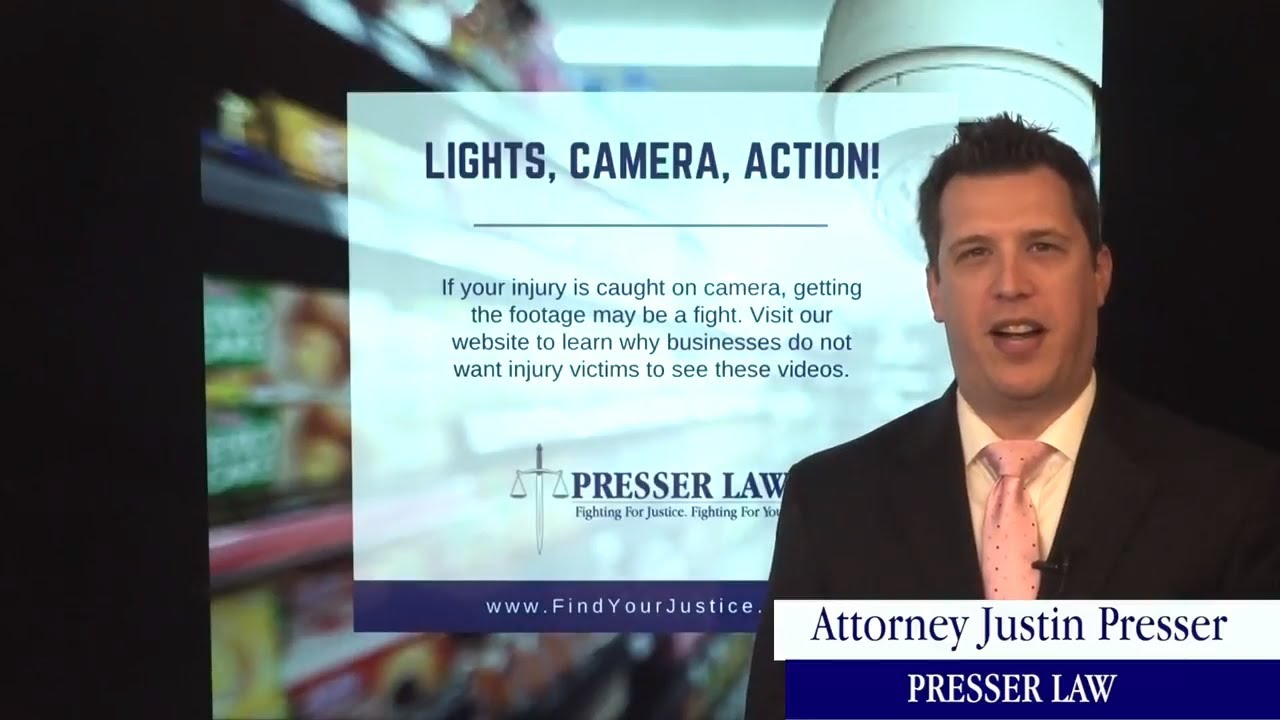

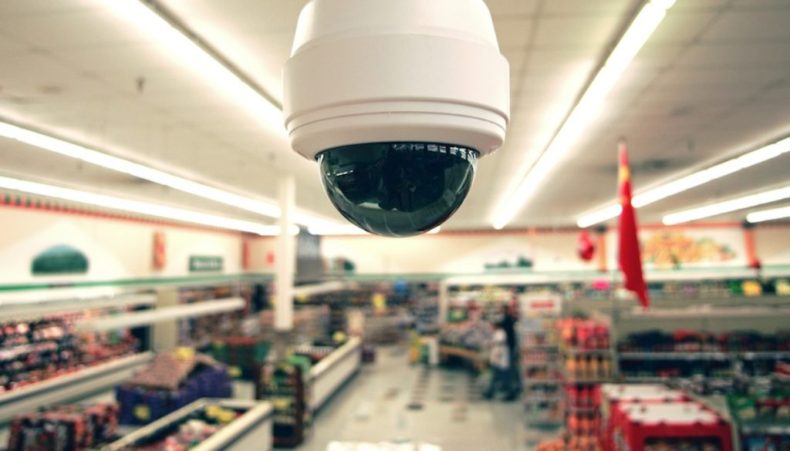
We now live in an age where technology is more and more pervasive in our lives. You can hardly go to any business without there being hidden or exposed surveillance camera. These cameras are designed to deter theft. On occasion, these cameras will capture individuals being injured.
Whether a slip and fall, trip and fall, a shootout at a gas station, or other injury event, obtaining the video of the incident can be a challenge. Businesses routinely refuse to produce them to injury victims. Often times it takes the filing of a lawsuit to force a business to produce the incident video. Even then, it is up to a court when the video has to be produced.
Surveillance Video v. Incident Video
Surveillance Video. This is when one party hires a private investigator to follow an injury victim. Surveillance videos caught by private investigators focus on capturing injuries, or lack thereof, of injury victims. When most people think of this type of surveillance video we think of Dick Tracy or someone hiding in the bushes secretly videotaping someone else. These videos are valuable tools in discrediting victim who lies about their injury or its affects.
Incident Video. This is created when a store’s theft deterrence camera captures an injury. Unlike surveillance video, which attempts to discredit a victim’s subjective complaints, incident video captures only objective facts. The concern in the use of surveillance videos is not present here. There is no subjective feeling that is attempting to be disproved. Instead, this video simply captures the cold, hard truth of how the incident occurred. It reminds us of the famous Dragnet quote by Sgt. Joe, “[a]ll we want are the facts.”
Background
The Incident video is valuable. It shows you exactly what happened. Unlike memories, it will not fade over time or alter its story. So you think businesses would want to produce these videos and exonerate their stores, right? Wrong.
Businesses tend to not voluntarily produce videos of the incident. Having a policy of never voluntarily producing incident video serves to hide instances where businesses are liable for injuries to their customers. If businesses only produced incident videos where they were not at fault, then injury attorneys would know that the refusal to produce a particular incident video may mean there is favorable footage. To prevent this, many business policies outright refuse to produce these videos voluntarily.
Another common reason for refusing to produce the incident videos is to paint the injury victim as having a bad memory. Businesses want injury victims to testify without seeing the video. They want to show how the injury victim’s memory differs from the event. Seems reasonable at first, right? However, sometimes injury victims are not asked how the incident happened until years after the incident. Have a difficult time remembering what you ate last week? Try remembering exactly what happened 14 months ago.
Businesses know memories fade. Businesses know that it is almost impossible to recall an event with complete accuracy. That is why these businesses show the video to their own employees before their employees testify. After watching the incident video, employees know exactly what happened. As a result, employee testimony is sometimes more accurate than the injury victim’s. Businesses use this to try to gain an advantage in court by arguing their recollection of the event is more accurate and trustworthy.
How Did We Get Here?
Dodson v. Persell involved a car accident. Dodson was injured when Persell ran into him. When Dodson filed a lawsuit, he asked Persell whether there was any surveillance taken of him by a private investigator and, if so, production of any such videos. Persell refused to answer. The issue made its way to the Florida Supreme Court which ruled, relevant here, that the contents of such private surveillance videos was privileged and not subject to discovery unless the party intended to use the footage at trial. Most importantly, the Court found no problem with the trial court exercising its discretion to require Dodson’s testimony before production of the surveillance video.
30 years after Dodson came Bolitho v. Home Depot USA, Inc. Bolitho was injured on the premises of Home Depot. The incident was captured on store video. When Bolitho requested to view it, Home Depot said it would not produce the video until after Bolitho’s testimony. Bolitho asked the court to compel Home Depot produce the video of how the incident happened. However, the court, citing Dodson’s “discretion” language refused. Instead, the court ordered Home Depo to turn over the incident video immediately after Bolitho’s testimony.
Since Bolitho, courts are split as to whether injury victims have a right to view incident video before their testimony and it is now the prevailing belief that the timing of when to produce incident video is up to the discretion of the court.
This change has further emboldened businesses to refuse to produce incident videos. One thing is clear, the fight is not over.
Conclusion
If you have been injured in a slip and fall or trip and fall and there is video of the incident, you need someone who will fight for the production of the video prior to your sworn testimony. I have won this battle in the past.


![[SIMPLE AND EASY] Reason Why You Need to Document the Injury Scene | Personal Injury Attorney](https://www.findyourjustice.com/wp-content/uploads/2025/10/SIMPLE-AND-EASY-Reason-Why-You-Need-to-Document-the-Injury-Scene-Personal-Injury-Attorney.jpg)