
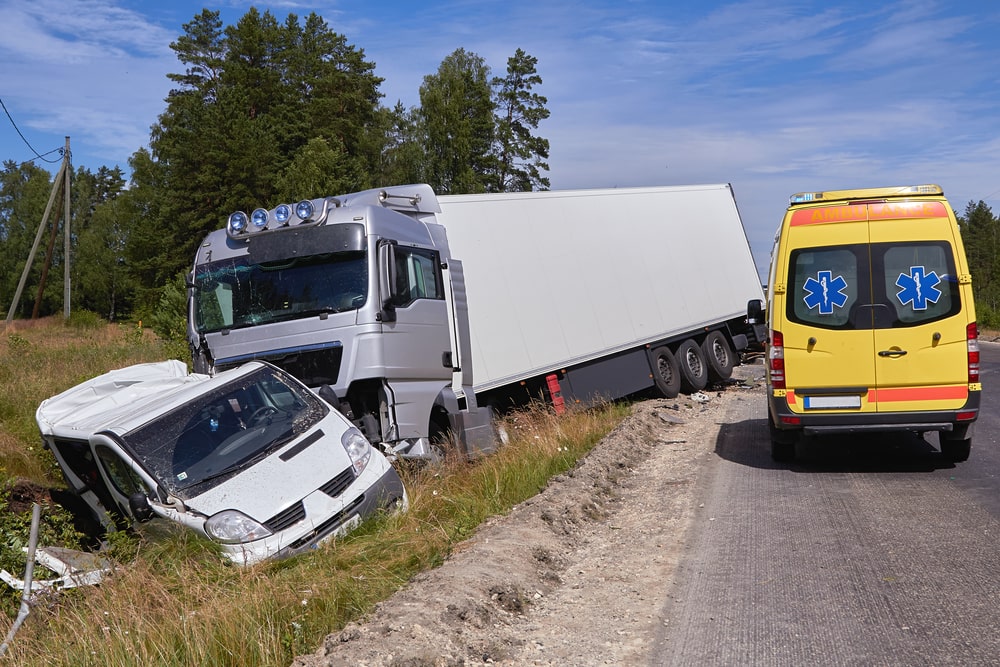
When a commercial truck is involved in a crash in Ocoee, the legal and factual questions that follow are fundamentally different from those in a standard car accident case. The size and weight of commercial vehicles, the regulatory framework that governs them, and the number of parties who may share liability all make truck accident claims more demanding to investigate and more consequential to get right.
The Weight and Force Difference
A fully loaded commercial truck can weigh up to 80,000 pounds. The average passenger vehicle weighs somewhere between 3,000 and 4,000 pounds. The disparity in mass means that the energy transferred in a truck-versus-car collision is not simply a larger version of a car-versus-car impact. The forces involved are categorically different, and the injuries they produce frequently involve traumatic brain injuries, spinal cord damage, internal organ trauma, and crush injuries that require extended hospitalization, surgery, and long-term rehabilitation.
The severity of these injuries directly affects the value of the claim, and the higher the value of the claim, the more aggressively trucking companies and their insurers will defend it. This is one of the reasons truck accident cases in Ocoee require a different approach than a standard auto accident claim.
Multiple Defendants and Multiple Insurance Policies
A car accident typically involves two drivers and two insurers. A commercial truck accident can involve multiple liable parties, including:
- The truck driver, for negligent operation at the time of the crash
- The motor carrier, for negligent hiring, supervision, or hours-of-service violations
- The cargo loading company, when improperly secured freight contributed to the accident
- The vehicle owner or lessor, when the truck itself was defective or improperly maintained
- The manufacturer of a component that failed and contributed to the crash
Pursuing only the most obvious defendant and ignoring others can leave significant compensation unrecovered.
Federal Regulations That Apply Only to Commercial Trucks
Commercial trucking is governed by a body of federal regulations administered by the Federal Motor Carrier Safety Administration that have no equivalent in standard car accident law. These regulations cover driver hours of service, vehicle inspection and maintenance, cargo securement, driver qualification, and drug and alcohol testing. When a carrier or driver violates these rules and a crash results, those violations are evidence of negligence and can form the basis of liability claims that go beyond what a standard negligence theory alone would support.
An Ocoee truck accident lawyer handles cases where gathering and preserving the regulatory evidence, including driver logs, electronic logging device data, inspection records, and qualification files, begins immediately after the client is retained because that evidence has a limited window of availability.
Evidence That Disappears Quickly in Truck Cases
Trucking companies and their insurers respond to serious crashes immediately. Their representatives begin collecting evidence, interviewing witnesses, and building a file designed to minimize liability within hours of an accident. Black box data that captures speed and braking in the seconds before impact can be overwritten. Driver logs can be altered. Surveillance footage is routinely destroyed. Acting quickly to place the carrier on formal legal notice to preserve all evidence related to the crash is one of the first steps in protecting any Ocoee truck accident claim.
Presser Law, P.A. is a Central Florida personal injury firm representing truck accident victims in Ocoee and throughout the greater Orlando area, including cases where the complexity of commercial carrier liability is matched by the seriousness of the injuries involved.
Taking Action After a Truck Accident in Ocoee
If you were seriously injured in a commercial truck accident in Ocoee, speaking with an Ocoee truck accident lawyer as soon as possible after your medical needs are addressed is the most direct way to preserve the evidence your case depends on and pursue the full range of parties responsible for your injuries.
![[SIMPLE AND EASY] Reason Why You Need to Document the Injury Scene | Personal Injury Attorney](https://www.findyourjustice.com/wp-content/uploads/2025/10/SIMPLE-AND-EASY-Reason-Why-You-Need-to-Document-the-Injury-Scene-Personal-Injury-Attorney.jpg)